


The Truth About Acne Scars: Treatments That Work (And Why)

Why Acne Scars Happen
When acne becomes inflamed—especially deep, cystic breakouts—it causes damage to the surrounding tissue. Your body responds by protecting the area and attempting to heal the wound, which triggers a collagen remodeling process.
But here’s the key:
If your body produces too little collagen, the skin heals indented (a depressed scar).
Acne scarring varies widely from person to person. Genetics, severity of acne, inflammation levels, and healing response all play roles in the type and severity of scarring.
.
Types of Acne Scars—and How to Identify Them
Understanding the kind of scar you have helps determine which treatment will be most effective.
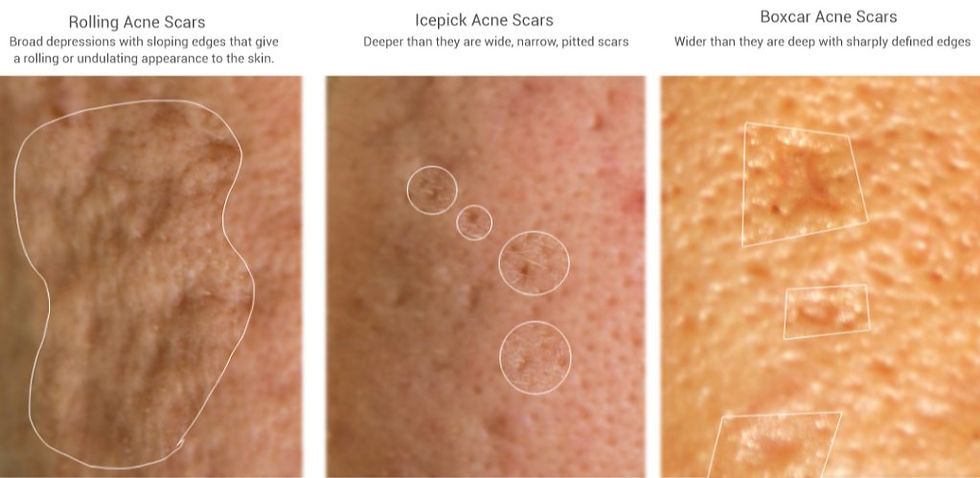
1. Ice-Pick Scars
These are small, deep pinpoint scars that look like tiny “holes” in the skin.
Why they happen: Severe inflammatory acne destroys deeper layers of tissue.
Best suited treatments: Microneedling series; combined with a TCA cross chemical peel application.
2. Boxcar Scars
These are wider indentations with sharper edges—almost like a pore that healed abruptly.
Why they happen: when inflammatory acne destroys collagen within a more shallow, broad area of the skin, leaving behind a sharply-edged “crater.” Often the result of long-term breakouts, picking, or repeated inflammation in the same area.
Best suited treatments: Microneedling, chemical peels, and laser for pigment/texture correction.
3. Rolling Scars
These scars appear as waves or dips across the skin, caused by tethering under the surface.
Why they happen: These scars are usually caused by long-term inflammatory acne and are often made worse by collagen and elastin breakdown as the skin ages.
Best suited treatments: Microneedling and Aerolase laser to break up scar tissue and rebuild collagen.
4. Post-Inflammatory Hyperpigmentation (PIH)
PIH is not a true scar—it's leftover redness or brown spots from inflammation.
Why it happens: when inflammation triggers excess melanin production during the skin’s healing process. This pigment rises to the surface and lingers long after the pimple is gone.
Best suited treatments: Chemical peels and Aerolase laser.
5. Post-Inflammatory Erythema (PIE)
Lingering redness from damaged capillaries.
Why it happens: caused by damage to the tiny capillaries beneath the skin during inflammation. When acne injures these vessels, they dilate or break, leading to lingering redness.
Best suited treatments: Aerolase for vascular correction.
How Microneedling Helps Treat Acne Scars
Microneedling is one of the most effective treatments for acne scarring because it directly targets the root problem: disorganized collagen.

How It Works
Microneedling creates controlled micro-injuries in the skin. This triggers the body’s healing response and stimulates new collagen and elastin production.
As new collagen forms:
Indentations rise
Texture smooths
Scars soften
Skin becomes thicker and healthier
Why It Works for Scars
Acne scars are the result of “broken” or malformed collagen. Microneedling encourages fresh, orderly collagen to rebuild, and properly fill, the damaged structure.
What to Expect
Most clients benefit from a series of 3–6 treatments, spaced 4 weeks apart. Improvements appear gradually over 2–3 months as collagen remodels.
How Chemical Peels Improve Acne Scars

Chemical peels help resurface the skin, fade discoloration, and smooth uneven texture. They are especially helpful for:
Superficial textural irregularities
Hyperpigmentation (PIH)
Mild rolling or boxcar scars
Red/brown acne marks that linger
Why Peels Work for Scarring
Peels accelerate cell turnover and encourage the production of new, healthy skin. Medium-depth peels (like the Perfect Derma Peel) also stimulate collagen at deeper layers.
What to Expect
Depending on the type of peel, you may experience:
Mild flaking (BioRePeel)
Several days of visible peeling (Perfect Derma Peel)
Most clients see best results with a series of 3–6 peels.
How the Aerolase Neo Elite Laser Treats Acne Scars
Aerolase is a multi-benefit laser that targets pigment, redness, inflammation, and collagen remodeling—all essential components of acne scarring.

How It Works
The Aerolase Neo Elite uses a 1064 nm wavelength to safely penetrate the skin and target:
Pigment: helps fade PIH and brown spots.
Hemoglobin: reduces lingering redness (PIE).
Water in the dermis: gently heats deeper tissue to stimulate collagen.
Acne bacteria: reduces inflammation, preventing future scarring.
Why It’s Unique
Aerolase is safe for all skin types, has no downtime, and can be used even on sensitive or recently broken-out skin.
What to Expect
A typical treatment plan includes 4–6 sessions, spaced every 2–4 weeks. Results build gradually as pigment fades and collagen forms.
Which Treatment Is Best for You?
Acne scars often benefit from a combined approach, because each treatment targets a different layer of the skin.
For example:
Microneedling → remodels collagen
Aerolase → improves texture, redness, pigment, and inflammation
Chemical peels → smooth surface texture and brighten discoloration
At Sanctuary Skin in Virginia Beach, we customize every plan based on scar type, skin tone, sensitivity level, and long-term goals.
Ready to Treat Your Acne Scars?
Whether your scars are deep, textured, pigmented, or red, the right combination of treatments can dramatically improve the look and feel of your skin.
Our team at Sanctuary Skin specializes in advanced corrective skincare and will help guide you toward a plan that fits your skin, your goals, and your timeline.
📍 Sanctuary Skin | Virginia Beach
📞 757-646-7985


Comments